
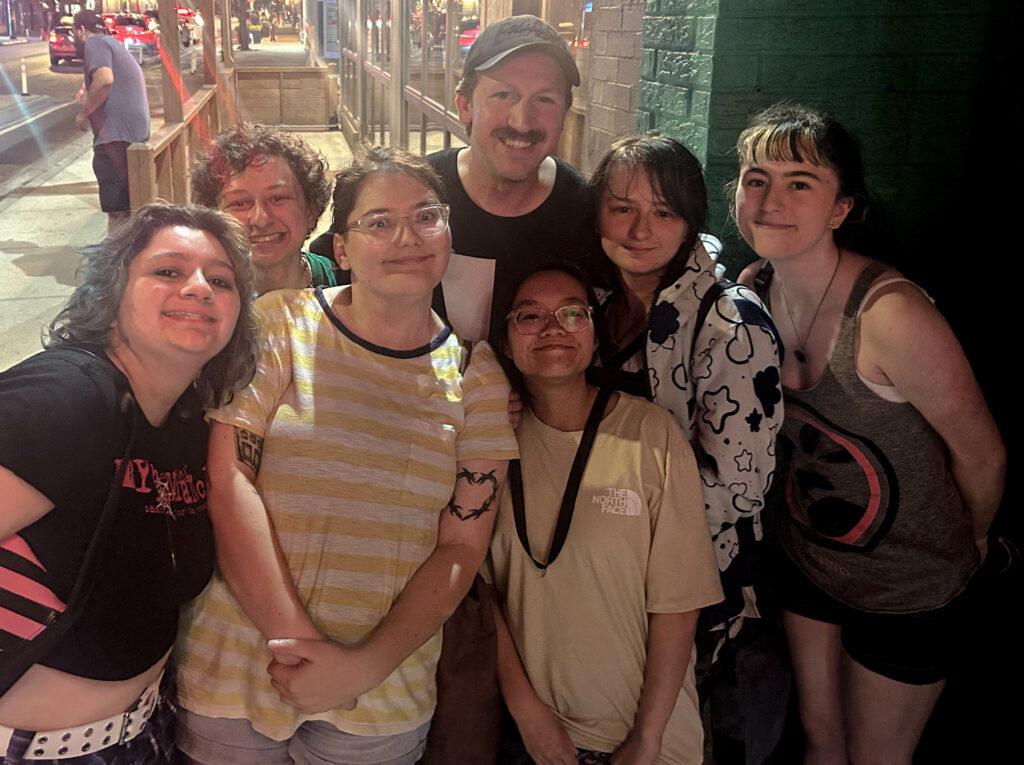
In 2025, FOBAT took a trip out to Chicago to meet up for some in-person archiving adventures. We also spent our time interacting with various band members and archivists. Mark Rose of Spitalfield was generous enough to meet up with us while he hosted karaoke at the Welcome Back Lounge in Logan Square. Big thanks to Mark for chatting with us about his various projects, big and small!
Joey: So, let’s talk about Landmine.
Mark Rose: Oh, wow. What an open! [LAUGHS]
Joey: Do you know Dave Hofer [of Dupage County Hardcore Archive]?
Mark Rose: Of course.
Joey: We were just with him at the [Chicago] Art Institute. He brought some of his cassettes and old stuff for us to see in person just for the fun of it.
Mark Rose: Nice! I love that.
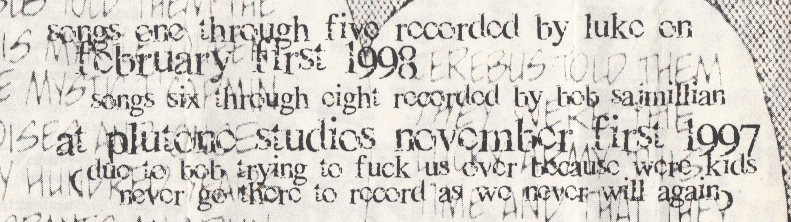
Joey: One of which was the Landmine cassette. And that one has always intrigued me because on the insert it says, “Due to Bob trying to fuck us over because we’re kids, never go there to record, as we never will again”, referring to Bob from Plutone. I am so curious. What the hell did he do?
Mark Rose: Oh, Plutone. I don’t really have much of a comment because… Is it the demo cassette you’re talking about?
Joey: Yeah, yeah.
Mark Rose: It’s interesting because I have such a great memory, and now you’re pushing me to my limits, where I’m like trying to remember what Bob did that was so wrong. Bob Maximillian [Sajmillian]? Huh. Wow. I don’t want to go on record saying anything bad about Bob because I don’t remember what that was all about. That’s a tough one! I’m sorry. You came in with a fastball.
Joey: Well, there you go. Squashing the beef here and now.
Mark Rose: Consider that squashed, sorry, I don’t have a better answer!
Joey: No problem at all. Moving on to, of course, Spitalfield. I believe there are only three music videos you guys did.
Mark Rose: Three official ones.
Joey: I think most of them are in pretty low quality on YouTube. Obviously, Victory Records doesn’t exist as an entity anymore. I don’t know what the legality of getting those in a higher quality released once again would be, but is that something you would ever be interested in doing?
Mark Rose: Getting the high-res videos back?
Joey: Yeah, and publishing them somewhere.
Mark Rose: Sure. I recently was able to claim the Spitalfield artist channel on YouTube, just in the last like few weeks. So now that we have a little bit of control, I could probably do some kind of re-upload. We don’t have the high-res files.
Also, I want to say that the low-res versions are what got uploaded when there was originally a big takedown. Then everything was re-uploaded because there was a period of time where the “I Loved The Way She Said LA” video had millions of views, and now it’s back down to hundreds of thousands. And I want to say it’s because everything got scrapped, and then things got re-uploaded, and clearly the re-uploaded versions were not nearly the high quality that YouTube is capable of now.
Joey: Right, Right.
Mark Rose: So if the question is, are we interested in it? Absolutely. I would rather there be the full quality videos that we put our heart and soul into and spent a lot of time on. That people spent money on and worked on.
So I would love that. I want to say that video number two for “Gold Dust” would be easier because of who made that video. It’s somebody that I have contact with.
Joey: Justin Thompson!
Mark Rose: Yeah, and so to find out if he has access to it, and also the legalities on us re-uploading it ourselves, or if they’re able to do some kind of switch. I know that there are a lot of artists who are into trying to replace music with current music, and I feel like that’s not really replacing. It’s just a quality upgrade. So I’m wondering if there’s a way to do that. But absolutely, would love to.
Joey: Speaking of that video, what do you recall about the legal troubles that Justin Thompson had with Victory after filming that music video? Or did you ever even know about that?
Mark Rose: Legal troubles with the filming? I don’t know about legal troubles. I mean, I know that there’s always a push and pull when it comes to allocated budgets for things.
Joey: Right.
Mark Rose: And knowing Justin and how hungry he was at that time. With the budget he was working with, there’s a good chance that budgets went over, and Justin was probably going out of pocket on a lot of things, and maybe that’s where it got a little ugly.
But I don’t really know what the results of said legal issues are. And Justin’s never really talked to me about that. So I don’t know. But I’ll say as a whole, with record labels and money, it’s never pretty.
Joey: Of course. Well, for some more context about that– There was a forum years ago called Light Blue Extra. Were you on it at all?
Mark Rose: Oh, yeah.
Joey: Justin posted on that years ago when he was filming that video, asking for advice from people on the forum. He had basically said, “Oh, I sent it in. They didn’t like the final cut. So I cut it again and sent it in again. And then they told me that I never sent it in and that they’re gonna send people after me. What do I do?” Something like that.
Mark Rose: I mean, that’s a whole ‘nother ball of wax. There’s a lot to unpack with the relationships between the bands, managers, producers, engineers, label, et cetera.
It’s a lot there, and it covers everything you can possibly think of. Because Victory had some tremendous success with a lot of bands. And they also ruffled a lot of feathers along the way. What’s tricky is that… A label like Victory is more like a community label, where there are fans that are drawn to the logo on the back that check out bands because of that logo; these bands are kind of like a family in a way. And therefore, when there’s new music, people have allegiances and alliances and things like that. And I think that, ultimately, that’s unique to certain scenes. I think that the punk/emo/indie/hardcore scene is one of those collective scenes where the label matters.
When you talk about major labels, they’re screwing artists left and right, too. You just don’t really hear about it much unless a band or an artist is so big that they can make it into a public thing. That did happen with a few of the Victory bands, too, where the bands that got the biggest were able to get in those legal battles and have it be part of their story, part of the publicity. Not for better, not for worse. I know bands that really had it rough. And I feel like everyone had their own story, even if they were similar.
Joey: I like that you have a nuanced opinion about it, because a lot of people we’ve talked to have just summed everything about Victory’s decline as, “Oh, yeah, Tony Victory. That guy was an asshole,” with very little context.
Mark Rose: But that should tell you something, too. I feel like there’s a lot there, and it’s tricky, and there are a lot of bands that would never have gotten where they did without the support of that label. And there are a lot of bands that were held back by that label. And it’s hard to know the inner workings of everybody. Also, you’re always looking for someone to blame when you’re in music. You’re always saying, ” This isn’t happening, and here’s why.” And again, it’s tricky. It’s very nuanced.
Joey: Makes sense! On the topic of the Light Blue Extra forum, here’s another question about that. Tons of old posts that we’ve seen on this forum give us very small nuggets of context for things. Drew Brown posted a lot on there, and there was a thread that asked: “What were all the bands that you’ve been in?” So he named a few, with relevant ones being: Leper, Anarchy Joe and the Dancing Cows, and I Hear They Call Themselves Ska.
Mark Rose: [LAUGHS] I love it.
Joey: So first of all, I assume Leper is actually the name of the band, right? Because the way that Drew phrased it was weird.
Mark Rose: Yes, Leper.
Joey: Okay, I’m assuming no, but did you guys ever record any music for these bands?
Mark Rose: [LAUGHS] No, only live shows for those bands that you just mentioned. I guess I Hear They Call Themselves Ska made some demos with a cassette, like a boombox. They didn’t even make it to Dave Hoffa. Those are things that, if we knew where they were, we would absolutely hand them over to Dave because Dave is the king at putting that stuff together.
Joey: Gotcha.
Mark Rose: There are live videos of those bands on YouTube if you look hard enough. Especially Leper, which is borderline a joke, but it’s very funny.
Joey: [LAUGHS] Okay, we’ll have to check it out. And were any of these bands your first band?
Mark Rose: My very first band was called The Bloody Stumps. It was with Ben Rose, the first drummer of Fall Out Boy.
Joey: Are you guys related?
Mark Rose: No, but we lived across the street from each other, and he’s one of my best friends.
Yeah, so Ben Rose, his brother Adam Rose, me, and Blake Croson from Spitalfield. That was The Bloody Stumps. We eventually dropped Bloody, and we were just The Stumps. That was our very first band. We started in sixth grade.
Joey: Wow, you were in that scene so young!
Mark Rose: And then Ben, of course, did his own record label. He played in a bunch of other bands too, and he was the first drummer on the very first demos of Fall Out Boy in his basement.
Joey: So, back to Landmine. You were doing Spitalfield and Landmine at the same time for a little bit.
Mark Rose: Briefly, yeah.
Joey: Yeah. How did you keep your voice intact for Spitalfield? How did that work? I know you weren’t screaming the ‘correct’ way with Landmine, that’s for sure.
Mark Rose: [LAUGHS] Well, I think the biggest thing is that early Spitalfield, around the time that Landmine and Spitalfield overlapped, I didn’t really know what I was doing anyway.
Joey: Yeah… [LAUGHS] I didn’t want to say that! The early stuff is still good, even with the rough parts.
Mark Rose: I mean, my voice when I was 15 was very different. Even a few years later, when we were recording more seriously, taking studio time more seriously, and even learning how to warm up and warm down. A lot of the stuff on the early recordings was done in a couple of takes because we didn’t even really understand the process of recording something.
I’d say that part of it was that we, neither [Landmine or Spitalfield], were really touring. So it wasn’t like it was night after night after night. Also, with Landmine, our sets were so short. Our average set was 15 minutes, if that. Sometimes it was 10. And because our songs were all like 40 seconds, we’d play like 10 songs in 10 minutes, and then it would be over. Even though I was screaming, it was also me and someone else. So it’s like half the time and very short. So even though I would wreck my voice, it would come back. Yeah, it wasn’t too bad.
Joey: Another band you had a brief stint in was Five Fingers Half a Hand. I know you weren’t a band member at the inception of that band, but do you know what the name means? Where did the name come from?
Mark Rose: No. It’s not on me at all. I joined much later, but I promise you it has a good meaning because. And I can give you the contact of who to ask about it because those guys were pretty artsy. They were into some deep stuff. They definitely have an answer for you. I don’t.
Joey: Right. And did you help with writing any of their material when you joined?
Mark Rose: Yes. So their whole full-length, I wrote all the keyboard parts and did some screaming on there too. I was a big part of that whole album. But I was not a big part of their early inception when they were first playing and first demoing and stuff like that. I only played a couple of shows with them, total, including their finale. The album came at the end of the band. That was kind of the swan song anyway. But yeah, I was not really a part of anything early on.
Joey: So most Spitalfield stuff is pretty well archived in the sense that a lot of it’s just on the Wayback Machine. Someone we would love to get more context for, however, is Baritone Man. Just in general, who the hell is he?
Mark Rose: Baritone Man might be here tonight. His name is Eric Peterson. He’s a friend of ours, and he put out a few songs on PureVolume where he was just singing other people’s songs in a low voice. And he called himself Baritone Man, but he would try to do it in like one or two takes as his own covers, but he’s just singing on top of the original. He’s not even making it original. It’s very funny. But anyway, because he was our buddy, we got him to do it on stage a few times, and then we recorded it in the studio. His older brother Soren is who engineered the new Spitalfield EP.
Joey: Oh, that’s so cool!
Mark Rose: Studio Soren was where I did a lot of my solo demoing. In fact, Soren’s dad, who’s a musician, recorded the very, very first Spitalfield demos that aren’t even on Hoffa’s site. So, we have a long-standing history with that family. And then Eric is an improv comedian here in Chicago. So he is the Baritone Man, and he sings here [karaoke night at Welcome Back Lounge]. He puts his name up as Baritone Man.
Joey: Oh, that’s awesome.
Mark Rose: I gotta jet right now, but this was fun.
Joey: All right, no worries. Thanks so much for chatting with us!